
Electric screwdrivers have been around for decades in professional repair settings, but a new category — compact precision electric screwdrivers specifically designed for consumer electronics — has made the tool genuinely useful for everyday people doing home repairs and device upgrades.
The question is not whether an electric screwdriver is better than a manual one in absolute terms. It is whether it is better for your specific situation. Here is the honest breakdown.
What is a Precision Screwdriver Set?
A precision screwdriver set is a collection of miniaturized screwdriver bits and handle designed for the small, specialized screw types found in consumer electronics. Unlike household screwdrivers which come in a handful of standard Phillips and flathead sizes, precision sets include:
- Pentalobe bits (PL): Apple's proprietary 5-pointed star screw. Found on iPhone bottoms and MacBook undersides. Not found in any standard toolkit.
- Torx bits (T): 6-pointed star screws used in game controllers, hard drives, laptop chassis, and many PC components. Common sizes: T3, T5, T6, T8.
- Phillips micro bits (#000, #00, #0): Much smaller than household screwdrivers. Using the wrong size strips heads instantly.
- Tri-Wing: Nintendo's proprietary 3-wing screw used on DS, Switch cartridges, and some Apple accessories.
- Hex (Allen) bits: Used in many laptop hinge screws and camera bodies.
- Spanner/security bits: Tamper-resistant screws used in public electronics and some proprietary devices.
Electric vs Manual: The Real Comparison
Where manual wins
Delicate final tightening: The last quarter-turn when closing a device requires precise torque control. Too tight strips the screw or cracks a housing. Manual screwdrivers give you direct tactile feedback for this step.
Single-screw tasks: Tightening a loose glasses screw takes 10 seconds with a manual driver. Setting up an electric driver for one screw is not worth the extra setup time.
Very small screws: Screws below M1.2 (smaller than 1.2mm diameter) require manual control to avoid overtorque damage. Most phone and laptop screws are M1.4 to M2.0, which an electric driver handles well.
Where electric wins
Multi-screw disassembly: Opening a laptop bottom panel involves 8 to 12 screws. Opening a MacBook Pro involves 10 to 14. Removing and reinstalling all of them manually causes wrist fatigue and takes significantly longer. An electric driver processes each screw in 2 to 3 seconds.
Repetitive assembly: If you repair devices regularly — replacing phone batteries, upgrading laptop RAM or SSD — the accumulated time and effort savings from electric driving are significant.
Wrist fatigue and accessibility: For users with limited hand strength, arthritis, or repetitive strain, electric driving reduces physical effort dramatically.
The FixMate Pro 78-in-1: What ‘78-in-1’ Actually Means
The FixMate Pro includes 78 interchangeable bits covering every screw type encountered in consumer electronics repair:
- Pentalobe P2 (iPhone) and P5 (MacBook)
- Phillips #000, #00, #0, #1, #2, #3
- Torx T3, T4, T5, T6, T7, T8, T9, T10, T15, T20
- Tri-Wing Y0, Y1, Y2
- Hex H1.5, H2.0, H2.5, H3.0, H4.0
- Flathead 0.6mm through 3.0mm
- Spanner/security bit types
- And many more covering cameras, drones, wearables, and specialty devices
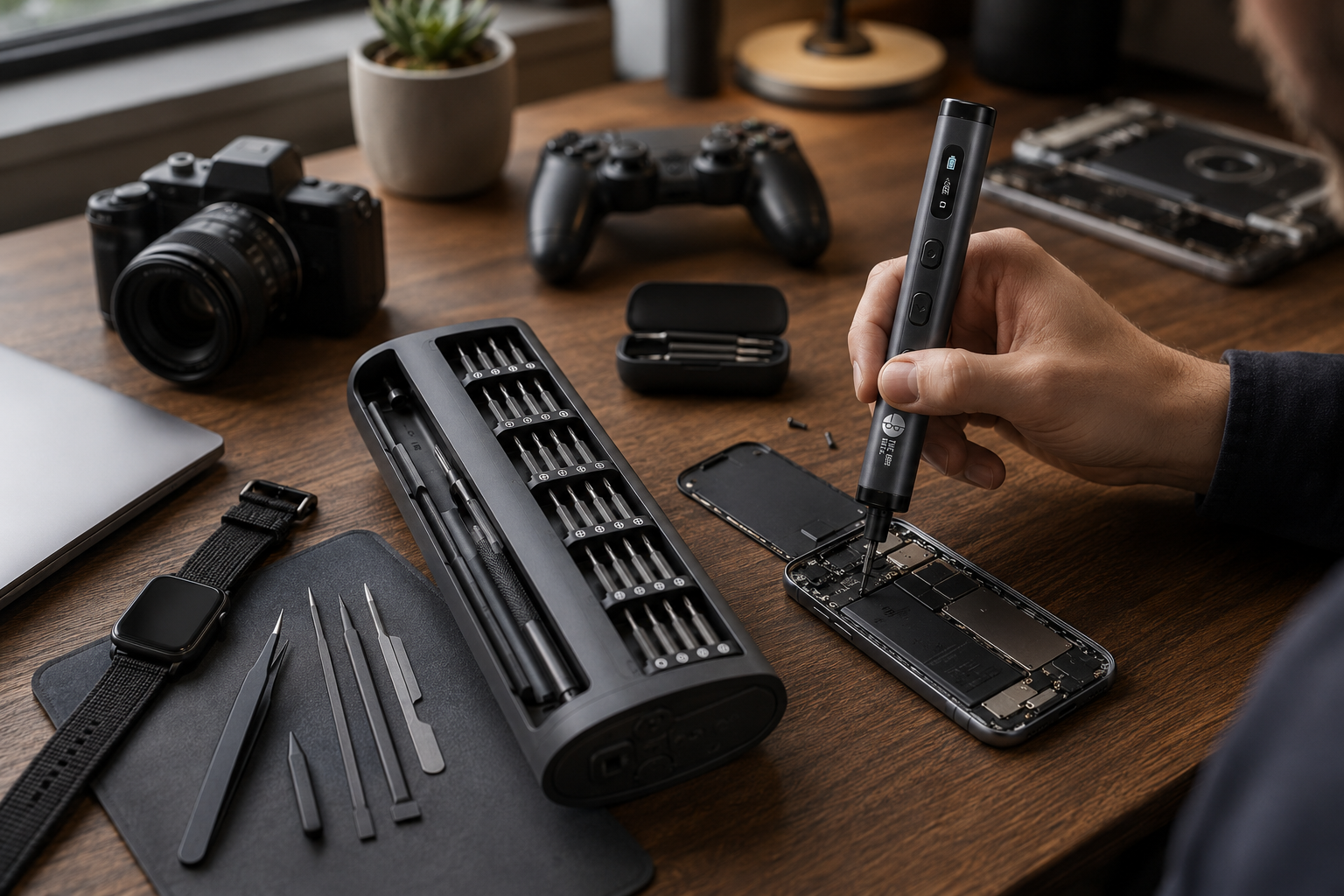
Everything stores compactly in a magnetic bit holder case that fits in a laptop bag or tool drawer. The electric drive unit is approximately pen-sized and charges via USB-C.
Shop FixMate Pro 78-in-1 Electric Screwdriver →
Real-World Repair Scenarios
iPhone battery replacement: Saves $60 to $100 compared to Apple or third-party repair shop. Requires Pentalobe P2 and Phillips #000 at minimum. The FixMate Pro covers all required bits. Without an electric driver, the process works but takes longer and requires more care on the pentalobe screws.
MacBook SSD or RAM upgrade: MacBook Air and older MacBook Pro models allow storage and memory upgrades. Requires Pentalobe P5, Torx T5, and sometimes T6. The electric driver handles the 10+ screws quickly; manual mode finishes with precise torque.
PS5 or Xbox controller thumbstick replacement: Common repair for stick drift. Requires T8 or T9 Torx. Multiple screws in a small space — ideal for electric driving with manual finish.
Eyeglasses: Tiny Phillips #000 or smaller. Manual with precise feel is better here. The FixMate Pro handles this in manual mode.
Laptop fan cleaning: Dust buildup is the most common cause of laptop overheating. Removing the bottom panel and fan screws, cleaning, and reassembling is a straightforward task that extends laptop life significantly. The electric driver makes the 10 to 15 screws fast and easy.
How to Choose Between Electric and Manual
Ask yourself one question: how many screws are you typically dealing with?
- 1 to 3 screws: Manual is fine. Not worth the electric driver setup.
- 4 to 10 screws: Either works. Electric saves time, especially on removal.
- 10+ screws: Electric driver pays for itself in time and wrist comfort on the first use.
The best approach for device repair is both modes: electric for speed on removal and reinstallation, manual for the final tightening torque. The FixMate Pro provides exactly this — a switchable electric/manual mode in the same tool.
Read More from The Geek Blog
Frequently Asked Questions
Is an electric screwdriver worth it for home electronics repair?
Yes, if you regularly do repairs involving more than 5 to 10 screws. Replacing an iPhone battery, upgrading a laptop SSD, cleaning a laptop fan — these all involve 8 to 15 screws that an electric driver processes in a fraction of the manual time. For occasional single-screw fixes, a manual precision driver is sufficient.
Can an electric precision screwdriver strip screws?
Yes, if used with too much torque or the wrong bit size. Quality electric precision screwdrivers like the FixMate Pro include adjustable torque and a manual mode specifically for delicate final tightening where direct feel matters. Use electric for removal and reinstallation, switch to manual for the last quarter-turn.
What is the difference between a regular electric screwdriver and a precision electric screwdriver?
Regular electric screwdrivers are designed for large fasteners in furniture, construction, and household applications. Precision electric screwdrivers use lower torque, smaller bit sizes, and include the specialized bit types (Pentalobe, Torx, Tri-Wing) required for consumer electronics. The FixMate Pro is a precision design for device repair, not a general construction tool.
How small are the screws in consumer electronics?
Most consumer electronics use screws between M1.2 and M2.5 in diameter — significantly smaller than standard household screws. iPhone screws are typically M1.2 to M1.6. MacBook screws range from M1.6 to M2.5. These sizes require precision bits that standard screwdrivers cannot handle without stripping.
Does the FixMate Pro come with a case?
Yes — all 78 bits store in a magnetic bit holder case that organizes them clearly and fits in a laptop bag or tool drawer. The electric drive unit is approximately pen-sized and stores alongside the bit case. The entire set is compact enough for a home office or travel repair kit.
How do I know which bit to use for my device?
iFixit.com publishes free repair guides for virtually every consumer electronics device with exact bit specifications. For iPhones and MacBooks, the most commonly needed bits are Pentalobe P2/P5, Phillips #000/#00, and Torx T5/T6. The FixMate Pro includes all of these and the storage case makes bit identification easy.