
Home blood pressure monitoring has become standard practice for anyone managing hypertension, cardiovascular health, or tracking changes over time. The question most people ask first: wrist monitor or arm cuff? The answer has nuance that most buying guides skip entirely.
How Each Type Measures Blood Pressure
Upper arm monitors (brachial artery): The cuff wraps around your upper arm and inflates to compress the brachial artery. The monitor detects oscillations in arterial pressure as the cuff deflates. This is the method used in clinical settings and is considered the reference standard for accuracy by the American Heart Association.
Wrist monitors (radial artery): The cuff wraps around your wrist and measures pressure in the radial artery. Modern wrist monitors using validated oscillometric technology produce clinically meaningful readings when used with correct positioning technique.
The Accuracy Question: What the Research Actually Shows
Clinical guidelines from the American Heart Association and European Society of Hypertension have historically preferred upper arm monitors as the reference standard. However, several important points apply:
The position factor outweighs the device factor. The single biggest source of measurement error in home blood pressure monitoring is body position — specifically, wrist height relative to heart level. A correctly positioned wrist monitor produces readings within clinically acceptable variance of an arm monitor. An incorrectly positioned wrist monitor (wrist below or above heart level) can be off by 10 to 30 mmHg, which is clinically significant.
Validated devices matter more than type. Whether arm or wrist, use a clinically validated monitor. Validated wrist monitors like the EasyPulse meet the same accuracy standards as validated arm monitors when used correctly.
Arm monitors are more forgiving of technique errors. This is the genuine practical advantage of arm monitors — they are less sensitive to minor positioning variations because the brachial artery site is less affected by limb position relative to heart level than the radial artery site.
When Wrist Monitors Are the Better Choice
- Travel and portability: Wrist monitors are compact enough to carry anywhere. An arm cuff is bulkier and harder to use in transit, in an office, or away from home.
- Large arm circumference: Standard arm cuffs do not fit all arm sizes. Wrist monitors accommodate all wrist sizes without the sizing issue common with arm cuffs.
- Frequency of monitoring: If your doctor has recommended monitoring multiple times daily in various settings, a wrist monitor makes this practical in ways an arm cuff does not.
- Independent use: Wrist monitors are easier to apply and use without assistance than arm cuffs for some users.
When Arm Monitors Are the Better Choice
- Medical supervision contexts: When monitoring under direct medical supervision for diagnostic purposes, arm monitors are the recommended standard.
- Atrial fibrillation or irregular heartbeat: The brachial artery reading is generally more reliable for arrhythmia detection. Some arm monitors include AFib detection; wrist monitors have limitations in this area.
- Users who struggle with correct wrist positioning: If you are not confident about positioning your wrist precisely at heart level consistently, an arm monitor's additional forgiveness may improve your measurement reliability.
The EasyPulse Positioning Advantage
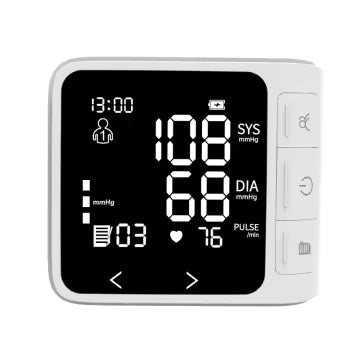
The EasyPulse wrist blood pressure monitor addresses the biggest weakness of wrist monitors directly: it includes a positioning indicator that confirms your wrist is at heart level before the measurement begins. This removes the most common source of wrist monitor error and brings the accuracy of home wrist monitoring significantly closer to arm monitor performance.
Shop EasyPulse Wrist Blood Pressure Monitor →
Understanding Your Blood Pressure Numbers
Blood pressure is expressed as two numbers: systolic pressure (the upper number, pressure when the heart beats) over diastolic pressure (the lower number, pressure between beats).
| Category | Systolic (mmHg) | Diastolic (mmHg) |
|---|---|---|
| Normal | Less than 120 | Less than 80 |
| Elevated | 120–129 | Less than 80 |
| High — Stage 1 | 130–139 | 80–89 |
| High — Stage 2 | 140 or higher | 90 or higher |
| Hypertensive crisis | 180 or higher | Higher than 120 |
| Low (hypotension) | Less than 90 | Less than 60 |
These guidelines are from the American College of Cardiology and American Heart Association (2017). Always discuss your readings and their implications with your healthcare provider.
Why Home Readings Differ from Clinic Readings
White coat hypertension: Many people have genuinely elevated blood pressure specifically in clinical settings due to the stress of the medical environment. Home readings are often lower and may more accurately reflect your day-to-day blood pressure.
Masked hypertension: The opposite phenomenon — normal readings at the clinic, elevated readings at home. Home monitoring catches this where a single clinical reading would not.
Natural variation: Blood pressure varies throughout the day, with activity, after meals, and with stress. Home monitoring captures this variation in ways a single clinic visit cannot.
Best Practices for Accurate Home Monitoring
Regardless of which type you use:
- Rest quietly for 5 minutes before measuring
- Avoid caffeine, exercise, and smoking for 30 minutes prior
- Sit with back supported, feet flat on the floor, legs uncrossed
- Take 2 to 3 readings one minute apart and record the average
- Measure at the same time each day for consistent tracking
- Keep a log with date, time, and both readings to share with your doctor
Read More from The Geek Blog
- How to Use a Wrist Blood Pressure Monitor Correctly →
- Ear Thermometer vs Forehead: Which is More Accurate? →
Frequently Asked Questions
Which is more accurate — wrist or arm blood pressure monitor?
Upper arm monitors are the clinical reference standard and are more forgiving of minor technique errors. Validated wrist monitors produce clinically acceptable readings when positioned correctly. The most important factor is consistent correct technique — a well-used wrist monitor beats a poorly used arm monitor for accuracy.
Why is wrist position so important for wrist blood pressure monitors?
The radial artery (measured at the wrist) is more sensitive to changes in limb position relative to heart level than the brachial artery (measured at the upper arm). A wrist below heart level artificially elevates the reading; above heart level artificially lowers it. The effect can be 10 to 30 mmHg — clinically significant.
Can I use a wrist blood pressure monitor if I have an irregular heartbeat?
Consult your doctor. For most wrist monitors, irregular rhythms can affect reading accuracy and some monitors may not detect all arrhythmias as reliably as validated arm monitors with AFib detection. If you have diagnosed atrial fibrillation, your doctor may recommend a specific device type.
How often should I measure my blood pressure at home?
For initial monitoring after a new diagnosis, twice daily — morning and evening — for at least a week is commonly recommended. For ongoing monitoring, once or twice daily or as directed by your healthcare provider. Always discuss your monitoring protocol with your doctor.
My home reading is very different from my doctor's reading. Which is correct?
Both may be correct — for different contexts. White coat hypertension (elevated readings at the clinic due to stress) and masked hypertension (elevated home readings, normal clinical) are real and common. Bring your home monitor to your next appointment for a direct comparison reading. Your doctor can assess whether the difference is clinically meaningful.
Are wrist blood pressure monitors approved by the AHA?
The American Heart Association recommends upper arm monitors as the preferred standard for home monitoring but acknowledges that wrist monitors can be appropriate when used correctly. Specifically validated wrist monitors — meaning those that have passed clinical accuracy validation studies — are considered acceptable. The EasyPulse uses clinically validated oscillometric technology.